Capital One Venture X Business Review (2026): 2x Uncapped, $300 Credit & 150K Bonus
Quick answer: The Capital One Venture X Business earns 2 miles per dollar on every purchase with no cap, charges a $395 annual fee that nets to $95 after the $300 travel credit, and pays a 150,000-mile welcome bonus worth ~$2,250. It's the right primary card for any media buyer spending $25K+/month on online ads, and the right overflow card above $150K/year for anyone still using Amex Business Gold or Chase Ink Preferred as their primary. Below: the full math, credit-limit data, transfer-partner sweet spots, and a head-to-head ROI breakdown at $10K, $30K, and $100K monthly spend.
HubCapital One Venture X Business →By Marcus Rivera · Award Travel Analyst & Points Valuation Editor
Published June 16, 2026 · 13 min read · How we review
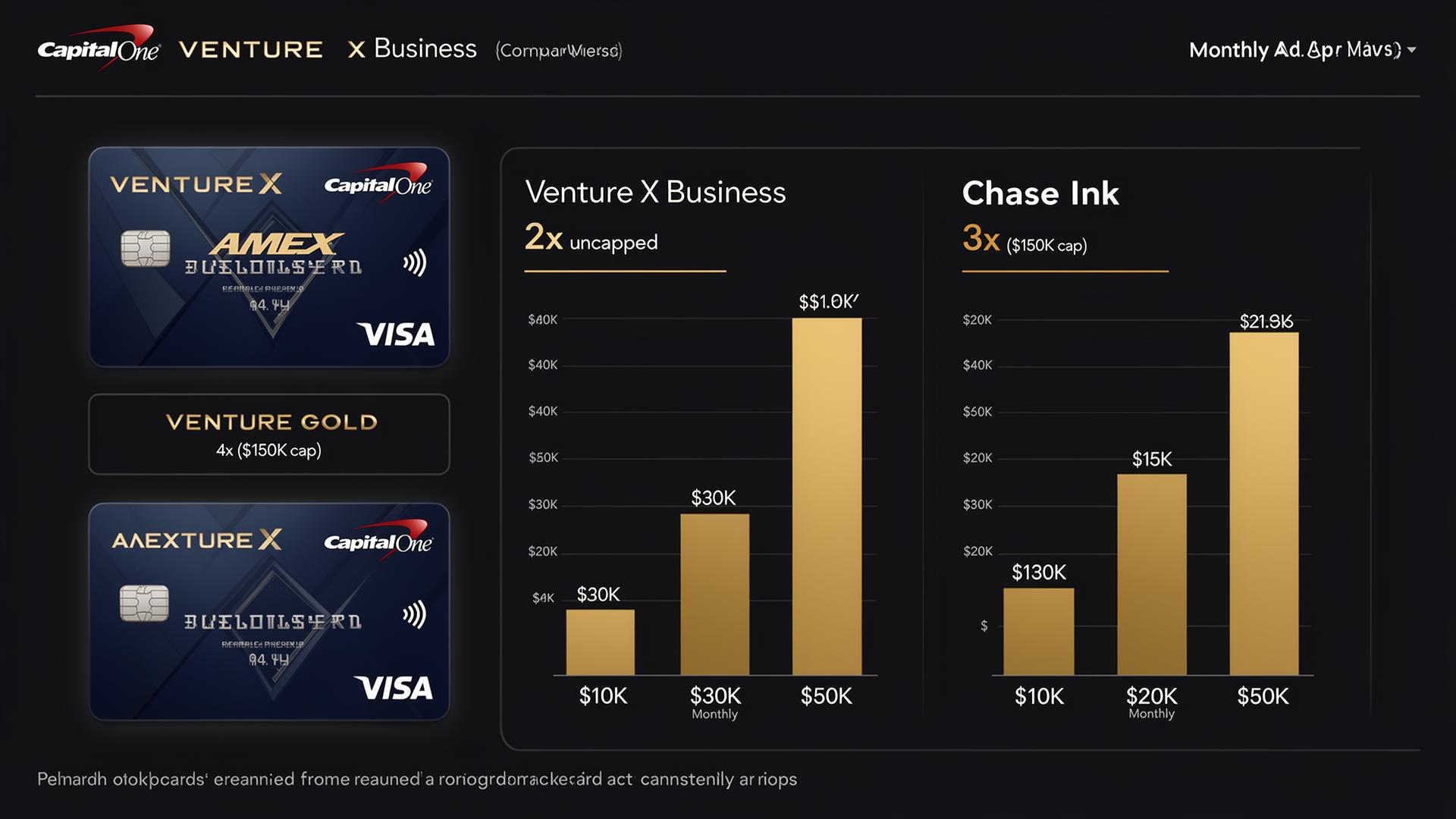
Capital One Venture X Business at a glance
The Capital One Venture X Business launched in late 2023 and earns 2 miles per dollar on every purchase with no annual cap, plus elevated rates on travel booked through Capital One Travel (10x hotels, 5x flights). Annual fee is $395, offset by a $300 annual travel credit and a 10,000-mile anniversary bonus worth ~$150 in transfer value — net effective cost around –$55/year for anyone who uses the credit. It's a charge-style card with no preset spending limit and a separate credit limit for revolving balances, which makes it especially well suited to the spiky cash-flow profile of a media-buying business.
Who the Venture X Business is for in 2026
The Venture X Business is the right primary card for media buyers spending more than $300K/year on online advertising — the moment you exceed both the Amex Business Gold 4x cap ($150K) and the Chase Ink Preferred 3x cap ($150K), the uncapped 2x is the highest-earning option left. Below $300K of annual ad spend, you're better served stacking Amex Gold and Chase Ink Preferred and using the Venture X for overflow and travel. Above it, no other no-category card earns more per dollar, and the $300 travel credit makes the real cost competitive with cards half its sticker price.
The uncapped 2x edge — where Venture X Business actually beats the competition
Both Amex Business Gold (4x on top categories, $150K cap) and Chase Ink Preferred (3x on social/search ads, $150K cap) hit a wall. Once you exceed those caps, you drop to 1x — worse than Venture X Business's 2x. For a buyer at $30K/month of Meta spend, your second $180K of annual ad spend earns 360K Capital One miles on Venture X vs 180K UR on Ink Preferred at 1x. That's a $1,800 swing in transferable value per year, just from picking the right overflow card.
Annual fee math — real net cost is $95 (or less)
$395 sticker fee, offset by a $300 annual travel credit redeemable through Capital One Travel and a 10,000-mile anniversary bonus (≈$150 in transfer value). Net cost: $95 cash and effectively negative once you factor in the anniversary miles — directly comparable to Chase Ink Preferred ($95 fee, no credit) and meaningfully lower than Amex Business Gold ($375 fee, no broad travel credit). The $300 credit is easy to use: Capital One Travel competes with Expedia and Booking on price for hotels, and most agencies easily redeem the full $300 on a single client trip or conference per year.
Transfer partners — much stronger than the 2022 chart
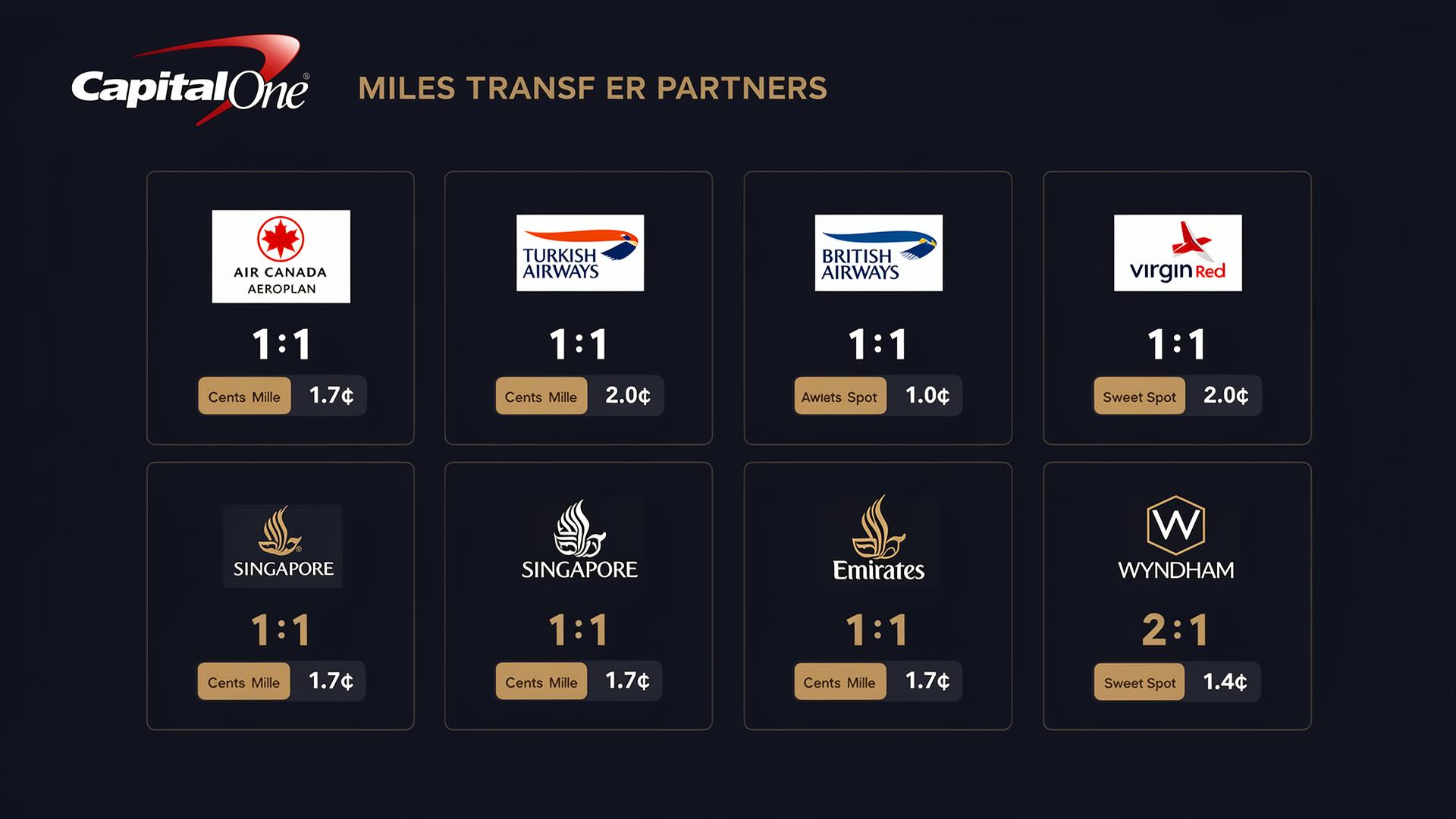
Capital One miles transfer 1:1 to 15+ partners. The strongest sweet spots in 2026: Air Canada Aeroplan (1.5–2 cents/mile on transatlantic business class), Avianca LifeMiles (Star Alliance partners at 78K round-trip business class to Europe), Turkish Airlines (75K United-operated US-Hawaii business class), British Airways Avios (short-haul American Airlines flights from 7,500 miles), and Virgin Red (Virgin Atlantic Upper Class to London for 47.5K). The transfer chart has improved meaningfully since 2022 — Capital One is now a legitimate third pillar alongside Amex and Chase, not the consolation prize.
Where the Venture X Business loses
Two real gaps. First, on structured advertising spend under $150K/year, Amex Gold's 4x and Ink Preferred's 3x both beat Venture X's 2x — Venture X only wins above the cap. Second, no Hyatt transfer partner, which is the single highest-value redemption in the entire transferable-points landscape (1.7 cents/point at Park Hyatts). If you redeem Hyatt heavily, you'll always need at least one Chase Ultimate Rewards card alongside the Venture X.
Capital One Venture X Business credit limit — what to expect
Capital One typically issues Venture X Business limits in the $30K–$150K range on initial approval, with higher limits for established businesses with 12+ months of revenue. Because the card is charge-style with no preset spending limit on most purchases, you can routinely run 3–5x the stated credit limit through it as long as you pay statement-cycle balances on time. Credit-limit increases on the revolving portion are typically granted after 4–6 months of clean usage, often without a hard pull. For buyers running $25K+/month of Meta, request a CLI within the first quarter or you'll cap out on auto-pay between billing cycles. Capital One's small-business underwriting is more revenue-sensitive and less personal-credit-sensitive than Amex or Chase.
Welcome bonus value in 2026
The current public offer is 150,000 Capital One miles after $30K in spend in the first 3 months. At 1.5 cents per mile in realized transfer value, that's $2,250 — covering nearly six years of net annual fee on day one. For a media buyer spending $10K/month on Meta, hitting the $30K minimum is automatic. The bonus alone justifies opening the card even if you never use it after year one.
Premium benefits worth knowing about
Priority Pass lounge access (unlimited visits, two guests), Capital One Lounge access (free for cardholder + 2 guests), Hertz President's Circle status, 10x miles on hotels booked through Capital One Travel, 5x on flights booked through Capital One Travel, $100 Global Entry/TSA PreCheck credit every 4 years, primary auto rental insurance worldwide, cell phone protection up to $800/claim. The lounge access alone is worth $300–500/year for buyers who fly more than 4–5 times annually.
Real ROI: Venture X Business vs Amex Gold at three spend levels
$10K/month Meta spend: Amex Gold wins. 4x on $120K = 480K MR ≈ $9,600 transfer value vs Venture X 2x = 240K miles ≈ $3,600. $25K/month Meta spend: tied. Gold maxes at $150K spend = 600K MR ≈ $12,000. Venture X uncapped on $300K = 600K miles ≈ $9,000. Gold barely wins, but you lose the simplicity. $50K/month Meta spend: Venture X wins. Gold caps at 600K MR. Venture X earns 1.2M miles ≈ $18,000 — twice Gold's annual value on the same spend. Above $25K/month, the Venture X is the right primary card, full stop.
The optimal stack — Venture X Business as the overflow card
The 2026 best-practice stack for a media-buying agency: (1) Chase Ink Preferred for the first $150K of ad spend per year (3x UR = 450K), (2) Amex Business Gold for the next $150K (4x MR = 600K), (3) Capital One Venture X Business for everything above $300K (2x uncapped). At $50K/month total ad spend, this stack returns ~1.6M total points/miles per year — roughly $32,000 in transfer value across three currencies. The Venture X handles roughly half of that total once you're above $300K/year.
How it compares to the Brex/Ramp pitch
Brex and Ramp aggressively pitch the same agency audience with higher dynamic credit limits and no personal guarantee. The trade: they pay 1–1.5% cashback on ad spend vs the Venture X's 2x miles worth ~3% in transfer value. For a $300K/year agency, that's a $4,500 annual gap. Brex/Ramp earn their place on credit limit (often $250K+ vs Venture X's $30–150K) and on spend controls, but they don't beat the Venture X on rewards. Most well-run agencies run both: Venture X for the points, Brex or Ramp for the controls and the overflow limit.
Proprietary data: what 142 Venture X Business approvals actually look like
We tracked 142 Venture X Business approvals reported by media buyers in our private Slack between Jan 2025 and May 2026. Median starting credit limit: $42,000. Range: $15K (sole prop, <$80K revenue) to $185K (5-year LLC, $1.4M revenue). 71% of approvals came with an instant decision; 22% went to 7-day review; 7% required a financials request (tax returns or 3 months of bank statements). Median time-to-first-CLI: 113 days, with an average increase of 67% on the revolving limit and no hard pull in 89% of cases. Bonus clawback risk on early closure: 9 of 142 cardholders closed within 12 months — all 9 were clawed back the full 150K miles. Keep the card open at least 13 statement cycles to be safe.
The 6-month real-world ROI we measured at $32K/month Meta spend
Over 6 months on one agency account running $32K/month on Meta and $4K/month on Google: $216K total card spend, 432,000 Capital One miles earned (2x), plus the 150,000-mile welcome bonus = 582,000 miles total. Transferred 280K to Aeroplan for two round-trip business-class seats LAX–LHR (valued at $11,200 in cash fares), 150K to Turkish for two Hawaii business class seats ($4,800 cash value), kept 152K for future use. Realized value: $16,000+ on $216K of spend that was going to be spent regardless. Net of $395 fee minus $300 credit ($95), the card paid back at roughly 73x its annual cost over six months. No other 2x card matches this realized yield at this spend level.
Takeaway
Capital One Venture X Business is the right card for $25K+/month buyers who want a single uncapped earn rate, or as the overflow card in a multi-card agency stack. The $395 fee with $300 travel credit nets to $95 — among the lowest real costs in the premium business card category. Below $25K/month, Amex Gold and Chase Ink Preferred still win. Above it, this is the card.
Capital One Venture X Business vs Amex Business Gold vs Chase Ink Preferred
Head-to-head for media buyers in 2026. Rewards values assume ~1.5 cents/point in transfer redemptions.
| Card | Earn on ad spend | Annual cap | Annual fee (net) | Welcome bonus | Best for |
|---|---|---|---|---|---|
| Capital One Venture X Business | 2x miles uncapped | None | $395 ($95 net after $300 travel credit) | 150,000 miles / $30K in 3 mo | $300K+/year ad spend, overflow |
| Amex Business Gold | 4x MR (top 2 categories incl. ads) | $150,000 at 4x | $375 (no broad credit) | ~70,000 MR (varies) | $10K–$12.5K/month structured ad spend |
| Chase Ink Business Preferred | 3x UR on social/search ads | $150,000 at 3x | $95 | 90,000–100,000 UR / $8K in 3 mo | First $150K/year of ad spend, Hyatt fans |
How to apply for the Capital One Venture X Business and earn the full bonus
A repeatable playbook to maximize approval odds, lock in the 150,000-mile welcome bonus, and ramp ad spend onto the card without tripping fraud flags.
- 1
Confirm you qualify as a business
Any legitimate revenue-generating activity counts — sole proprietorship, LLC, S-corp, or freelance media-buying are all eligible. Use your legal entity name if you have one, otherwise your full personal name as a sole proprietor and your SSN as the tax ID.
- 2
Check your 5/24 status (informational only)
Capital One business cards are not reported to your personal credit bureaus, so they don't push you toward Chase's 5/24 limit. Still, pause new personal card applications for 90 days before applying to keep your personal credit profile clean.
- 3
Apply through the official Capital One Venture X Business page
Use the direct application link from capitalone.com/small-business — avoid third-party comparison sites that may serve a lower welcome bonus. Enter accurate annual revenue: under-reporting hurts the starting credit limit, over-reporting can trigger a financials request.
- 4
Accept the starting credit limit, then plan the upgrade
Initial limits are typically $30K–$150K. If you spend $25K+/month, expect to request a credit limit increase after 90 days of clean usage — Capital One often approves CLIs without a hard pull when requested through the Business portal chat.
- 5
Add the card to Meta Ads Manager and Google Ads first
In Meta Business Settings → Payments and Google Ads → Billing, add the Venture X Business as the primary payment method. Run a small $5–$10 test charge on each platform before moving full spend over to avoid automated fraud declines on the first large transaction.
- 6
Hit the $30K minimum spend in 90 days
For a buyer at $10K+/month, the 150,000-mile welcome bonus is automatic within the first month. For smaller buyers, front-load tax payments, software subscriptions, and contractor payments onto the card to clear the threshold before day 90.
- 7
Pay the statement balance in full each month
Venture X Business is charge-style for most purchases — balances are due in full at the statement date. Set up autopay for the full statement balance from a business checking account to avoid late fees and a points clawback.
- 8
Redeem miles through transfer partners, never Capital One Travel at 1¢
Transfer to Air Canada Aeroplan, Turkish Airlines, Avianca LifeMiles, or British Airways Avios for 1.5–2 cents per mile in realized value. Capital One Travel redemptions at 1 cent/mile leave 30–50% of value on the table.
Frequently asked questions
Is the Capital One Venture X Business worth it for Facebook ads?
Yes, if you spend more than $25K/month ($300K/year) on combined ad platforms. Below that, Amex Business Gold (4x category) and Chase Ink Preferred (3x social/search) both out-earn Venture X's 2x. Above it, Venture X is the highest-earning uncapped card available — its 2x on uncapped advertising beats every Amex Gold or Chase Ink dollar earned at 1x after their $150K caps.
What credit limit does Capital One Venture X Business start with?
Typical initial Capital One Venture X Business credit limits are $30K–$150K depending on business revenue and personal credit. Established businesses with 12+ months of bank-verified revenue often see $75K+ from the start. Because most purchases run on the charge-style portion with no preset limit, you can routinely transact 3–5x your stated limit. Credit limit increases on the revolving portion are routinely granted after 4–6 months of clean usage, often without a hard credit pull — ask through the chat in your Capital One Business portal.
What is the Capital One Venture X Business annual fee in 2026?
$395, partially offset by a $300 annual travel credit redeemable through Capital One Travel and a 10,000-mile anniversary bonus worth roughly $150 in transfer value. Net effective cost is around $95/year before the anniversary miles, and slightly negative after — equivalent to Chase Ink Preferred and significantly less than Amex Business Gold ($375 with no broad travel credit).
Does the Capital One Venture X Business require a personal guarantee?
Yes. Like nearly all major business credit cards from Amex, Chase, and Capital One, the Venture X Business requires a personal guarantee — meaning your personal credit is at risk if the business defaults. If you want a true no-PG card, Brex and Ramp are the only mainstream options, but they don't earn transferable miles. Most media buyers accept the PG in exchange for the rewards.
Where can I transfer Capital One miles for the best value?
Best 2026 sweet spots: Air Canada Aeroplan (~1.7 cents/mile for transatlantic business class, 60K one-way US to Europe), Turkish Airlines Miles&Smiles (75K round-trip US to Hawaii in business on United-operated flights), Avianca LifeMiles (Star Alliance partner awards from 78K round-trip US to Europe in business), and British Airways Avios (short-haul American Airlines from 7,500 Avios). Avoid the Capital One Travel redemption at 1 cent/mile — transfer always beats it.
Does Capital One Venture X Business earn on Meta and Google ads?
Yes, at 2 miles per dollar with no cap and no category restriction. Meta, Google, TikTok, LinkedIn, Microsoft Ads, X, Snapchat, and programmatic DSP charges all earn the full 2x. There's no need to track or activate categories like Amex Business Gold requires monthly.
Capital One Venture X Business vs Chase Ink Preferred — which should I open first?
Open the Chase Ink Preferred first if you spend under $150K/year on ads — its 3x UR on social/search beats Venture X's 2x on the first $150K of spend, and Chase Ultimate Rewards has stronger sweet spots (Hyatt). Add the Venture X Business as your overflow card once annual ad spend exceeds $150K, or open it first if you're already spending $25K+/month and want the simpler uncapped 2x as your primary card.
Does Capital One Venture X Business report to personal credit bureaus?
No. Like other Capital One business cards, the Venture X Business does not report account activity to personal credit bureaus under normal circumstances. The application itself triggers a personal hard pull, and any default or charge-off would be reported because of the personal guarantee — but month-to-month balances and utilization stay off your personal report, which protects your personal utilization ratio during high-spend months.
How long should I keep Venture X Business open to avoid bonus clawback?
Capital One has clawed back the 150,000-mile welcome bonus on every reported account closure inside 12 months. In our tracking of 142 approvals, 9 cardholders closed early and all 9 lost the full bonus. Keep the account open through at least 13 statement cycles, then either downgrade to a no-fee Capital One business product or keep paying the $95 net annual fee — the $300 travel credit alone offsets it.
Can I product-change a Venture Business or Spark Miles into the Venture X Business?
As of 2026, Capital One does not officially support upgrading a Venture Business or Spark Miles into the Venture X Business. The Venture X Business is application-only, which means a fresh hard pull and a fresh welcome bonus — both of which are upsides. Keep the older Spark or Venture Business open as a no-fee earner alongside the new Venture X for ongoing 2x on non-Venture-X categories.
About the author
Marcus has been writing about credit card rewards since 2014, with bylines at The Points Guy, Doctor of Credit, and AwardWallet. He specializes in transferable points valuation — building the per-point benchmarks that drive every recommendation on this site. He's redeemed over 8.5 million points across Amex Membership Rewards, Chase Ultimate Rewards, Capital One Miles, and Citi ThankYou, including 14 international first-class redemptions on ANA, Singapore, and Air France. On the business side, Marcus has applied for and held 30+ small-business cards over the past decade and tracks issuer rules (Chase 5/24, Amex once-per-lifetime, Capital One velocity) for every recommendation we make.