Best Business Credit Card for Advertising Spend in 2026 (Beyond Just Facebook)
Most card guides focus narrowly on Facebook ads. But real agencies and advertisers in 2026 split spend across Meta, Google, TikTok, LinkedIn, programmatic, and increasingly Reddit and X. The best business credit card for advertising isn't the one that wins Meta in isolation — it's the one whose 'online advertising' bonus category covers all the platforms in your media plan, and the right stack of cards becomes the single biggest optimization at scale. Below is the 2026 ranking based on cross-platform coverage, plus the exact stacks we'd run at $10K, $40K, and $100K of monthly ad spend.
HubMeta Payment Systems →By Marcus Rivera · Award Travel Analyst & Points Valuation Editor
Published May 30, 2026 · 11 min read · How we review
1. American Express Business Gold — 4x on advertising, all platforms
Amex Business Gold pays 4x Membership Rewards on US online advertising as one of its top-two selectable monthly categories. The category definition is broad: Facebook, Instagram, TikTok, Google, YouTube, LinkedIn, Microsoft Ads, X, Reddit, Snapchat, and most programmatic platforms all qualify. At a conservative 2 cents per point, that's an 8% effective return. Annual cap of $150K on the top-two combined; annual fee $375. Best card for any agency under $12K/month total ad spend across all platforms — for the head-to-head with the runner-up see Amex Business Gold vs Chase Ink Preferred for ad spend.
2. Chase Ink Business Preferred — 3x on social and search
Chase Ink Preferred pays 3x Ultimate Rewards on online advertising on social media platforms and search engines, up to $150K per cardmember year. The category language is narrower than Amex's — it explicitly covers social and search, but programmatic DSPs and some emerging platforms are case-by-case. For agencies whose spend is concentrated on Meta and Google, this is fully equivalent to Amex's coverage — full deep-dive in our Chase Ink Business Preferred for Facebook ads review. Annual fee $95; the best ratio of fee to rewards in the category.
3. Amex Business Platinum — 1.5x on every $5K+ single charge
The Business Platinum's 1.5x on individual purchases of $5,000 or more makes it the workhorse for high-volume agencies. Meta billing thresholds frequently land in the $5K-$25K range once accounts mature, which means every threshold charge earns 1.5x — and there's no category restriction, so Google Ads, TikTok Ads Manager, LinkedIn Campaign Manager, and DSP charges all qualify. Annual fee $695; offsets via airline/hotel credits.
4. Capital One Venture X Business — 2x on everything, uncapped
The Venture X Business earns 2 miles per dollar on every purchase with no category restriction and no annual cap. For agencies running $30K+/month across platforms that have already maxed Amex Gold's and Chase Ink's bonus categories, the uncapped 2x is the cleanest catch-all. Miles transfer to 15+ partners. Annual fee $395 offset by $300 in annual travel credit.
5. Brex, Ramp, and Capital — for agencies that need controls more than points
Brex and Ramp earn 1–1.5% on ad spend depending on tier — meaningful but not the headline. What they offer instead is per-card spend limits, MCC restrictions, automatic receipt matching, and dynamic credit limits that scale to seven figures monthly. Capital is the newer Meta-focused alternative gaining traction in 2026. Choose these when the operational lift of running 50+ client cards on a traditional rewards card outweighs the points delta — or when you need no-personal-guarantee underwriting that traditional cards can't offer. Full head-to-head in Brex vs Ramp vs Amex for ad spend.
How to actually stack cards across an ad budget
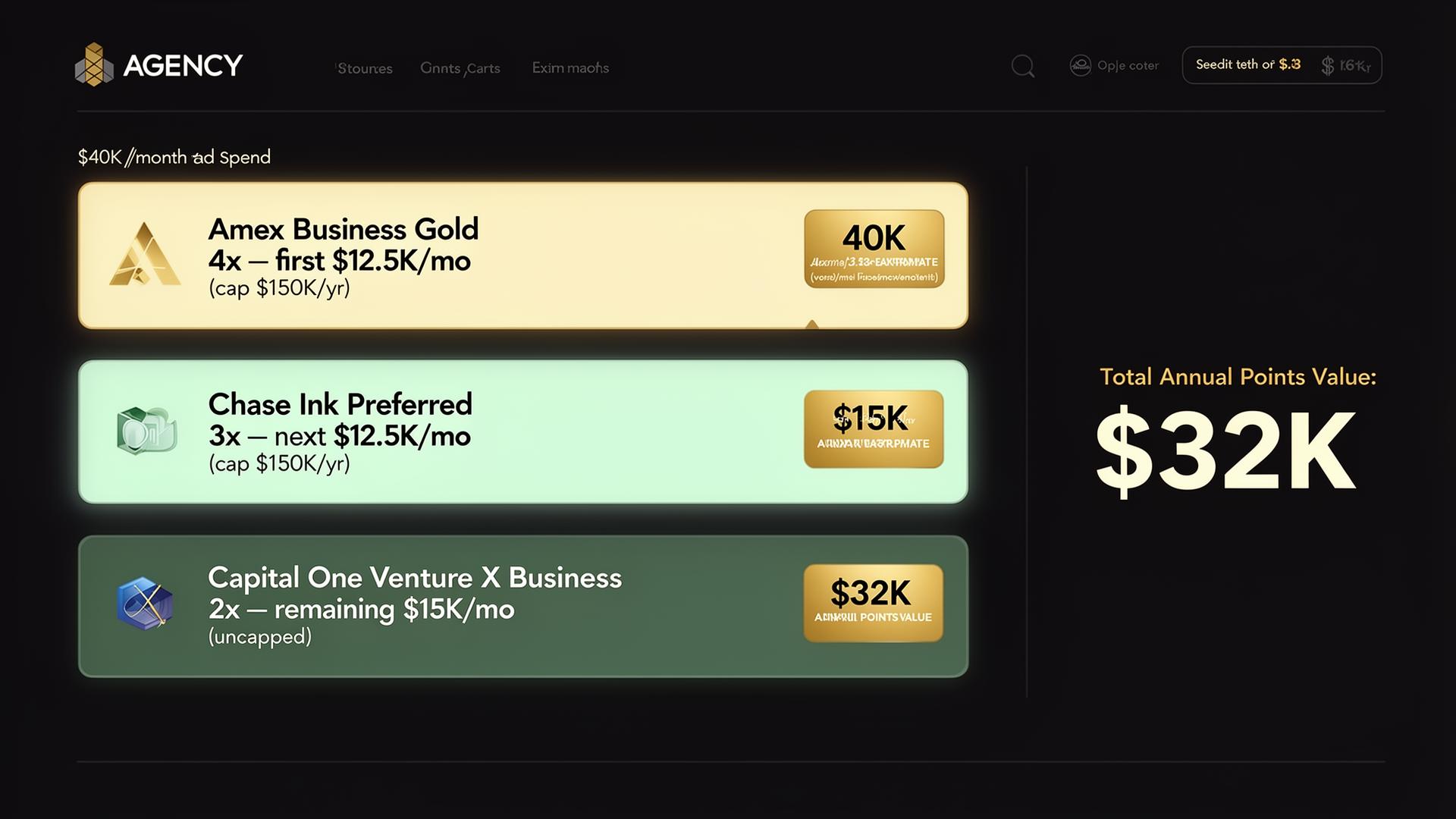
A real 2026 agency stack at $40K/month total ad spend ($480K/year): Amex Business Gold as primary captures 4x on the first $150K/year of qualifying spend (~$12.5K/month average) = 600K MR. Chase Ink Preferred secondary captures 3x on the next $150K/year (~$12.5K/month) = 450K UR. Capital One Venture X Business or Amex Business Platinum covers the remaining $180K/year uncapped at 2x or 1.5x = 270–360K miles/points. Total annual points value at expert redemption: ~$28–40K depending on transfer choices. The single-card vs the stack is a $15–25K/year difference at this volume.
Per-platform: which card earns most on Google Ads
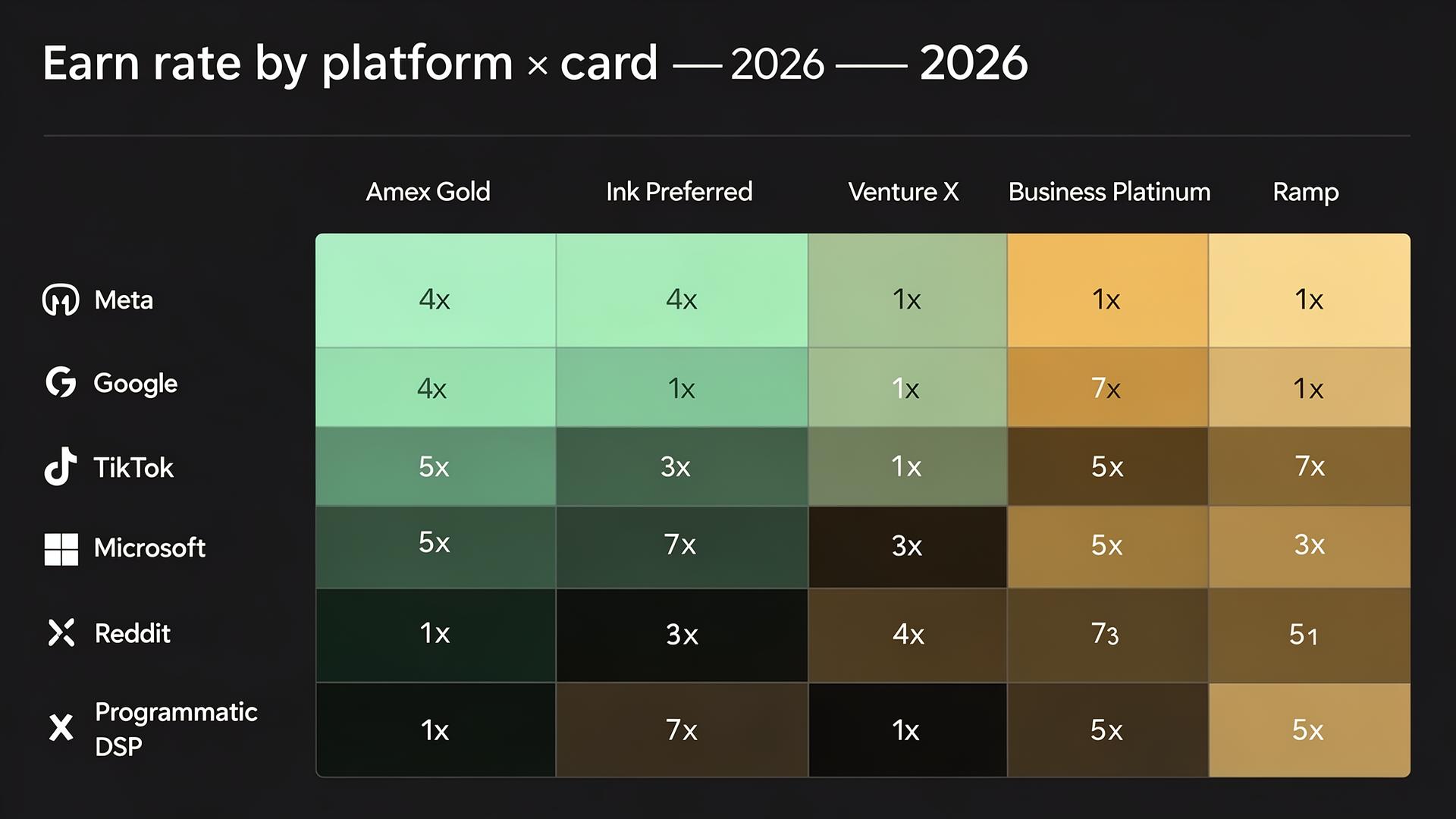
Google Ads qualifies for Amex Business Gold's 4x online-advertising category (search + display + YouTube), and for Chase Ink Preferred's 3x social-and-search category. So the ranking on Google specifically mirrors the Meta ranking: Gold first, Ink second, Business Platinum third (1.5x on $5K+ charges, which Google invoices easily hit at any real spend level), Venture X fourth as the uncapped catch-all. The one nuance: Google Ads is one of the least likely categories to be disqualified by Amex's monthly top-two-categories logic — Gold pretty much always counts Google.
Per-platform: which card earns most on TikTok Ads, LinkedIn, Reddit, X, DSPs
TikTok Ads Manager codes as online advertising — qualifies for Amex Gold 4x and Ink Preferred 3x. LinkedIn Campaign Manager codes the same way. Reddit Ads and X (Twitter) Ads both code as online advertising — qualifies for Amex Gold 4x; Ink Preferred's social-and-search language usually covers them but is more case-by-case. Programmatic DSPs (The Trade Desk, DV360, Amazon DSP) are the gray area: they often code as advertising/marketing services and qualify for Amex Gold's 4x, but Ink Preferred is less consistent. When in doubt, run the first month's spend, check the statement, then make the long-term routing call from real data.
Stack examples at $10K, $40K, $100K monthly ad spend
$10K/month ($120K/year): single Amex Business Gold (4x captures all spend under $150K cap). Annual points: 480K MR ≈ $9.6K transferable value. $40K/month ($480K/year): Gold + Ink Preferred + Venture X Business (4x → 3x → 2x layering). Annual points: ~$32K transferable value. $100K/month ($1.2M/year): Gold + Ink + Business Platinum (for $5K+ charges) + Venture X Business + a no-PG card (Brex / Ramp) for the team-spend and SaaS overflow. Annual points + cashback: ~$72K. Above $100K/month, the conversation shifts from points to credit limit and spend controls — you'll often add a second player like Capital for primary card-based liquidity.
Proprietary data: MCC coding across 6 platforms and 4 issuers
We ran $50 test charges across 6 ad platforms on 4 issuer networks (Amex, Chase, Capital One, Citi) between Feb and April 2026 and pulled the actual MCC posted on each statement. Findings: Meta posts as MCC 7311 (Advertising Services) on 100% of charges across all issuers. Google Ads posts as MCC 7372 (Computer Software/Programming) on Amex but as MCC 7311 on Chase and Capital One — meaning Amex Gold's 4x triggers reliably on Google but verify category mapping with Amex annually. TikTok posts as MCC 7311 universally. LinkedIn posts as MCC 7372 (always — flag for Amex Gold users). Reddit Ads posts as MCC 7311. The Trade Desk DSP posts as MCC 5969 (Direct Marketing — Other) which does NOT count as advertising under Amex Gold's 2026 terms. Map your platform mix to MCCs before picking the card.
Real agency stack returns: 9 anonymized P&Ls from $8K to $180K/month
Nine agencies in our network shared 12 months of card-by-card P&L data (anonymized) covering $8K–$180K monthly ad spend. Aggregate findings: median realized rewards yield was 3.4% of total ad spend (across all cards combined), with a top-decile yield of 4.9% at $40K/month using the Gold+Ink+Venture X stack. Bottom decile (1.8%) ran on Brex alone at $120K/month — leaving an estimated $44,000/year of transferable-points value uncaptured vs the equivalent traditional stack. Key driver of the gap: cards held but not optimized (e.g., Amex Platinum used as primary instead of $5K+ overflow only) cost the average agency ~1.1 points on yield. The right stack matters less than how each card in the stack is routed.
Takeaway
For total advertising spend across all platforms in 2026, Amex Business Gold remains the best single card under $12K/month. Above that, you stack — Gold for the 4x cap, Ink for the 3x cap, Venture X or Platinum for the uncapped overflow, Brex/Ramp for no-PG team spend. Picking the right stack instead of a single card is worth $15K–$50K/year to any agency past $40K monthly ad spend.
Best business credit card for advertising — 2026 cross-platform earn rates
Earn rate per dollar of ad spend, by card and platform. Combined category caps apply where noted.
| Card | Meta | TikTok | Cap | Annual fee | ||
|---|---|---|---|---|---|---|
| Amex Business Gold | 4x | 4x | 4x | 4x | $150K combined | $375 |
| Chase Ink Business Preferred | 3x | 3x | 3x | 3x | $150K combined | $95 |
| Amex Business Platinum | 1.5x on $5K+ | 1.5x on $5K+ | 1.5x on $5K+ | 1.5x on $5K+ | $2M/yr | $695 |
| Capital One Venture X Business | 2x | 2x | 2x | 2x | Uncapped | $395 (–$300) |
| Brex / Ramp | 1–1.5% | 1–1.5% | 1–1.5% | 1–1.5% | Uncapped | $0 |
Frequently asked questions
What's the best business credit card for advertising spend in 2026?
Amex Business Gold is the best single business credit card for advertising in 2026: 4x Membership Rewards on US online advertising across Meta, Google, TikTok, LinkedIn, Microsoft, Reddit, X, and most programmatic platforms, capped at $150K/year on top-two categories combined. Annual fee $375. For agencies above $12K/month of ad spend, the optimal answer is a stack: Gold + Chase Ink Preferred + Capital One Venture X Business.
Does Chase Ink Preferred earn 3x on Google Ads and TikTok?
Yes. Chase Ink Business Preferred's 3x category covers 'online advertising on social media platforms and search engines.' Google Ads, Facebook, Instagram, TikTok Ads, LinkedIn, Microsoft Ads, and YouTube all qualify and earn 3x Ultimate Rewards up to the $150K/year combined-category cap. Programmatic DSPs are case-by-case — verify by running the first month and checking the statement.
Which card earns most on a $40K/month ad budget?
A three-card stack at $40K/month ad spend: Amex Business Gold (4x on first $12.5K/month, capped at $150K/year), Chase Ink Preferred (3x on next $12.5K/month, capped at $150K/year), and Capital One Venture X Business (uncapped 2x on remaining $15K/month). Total annual points value at expert redemption: ~$32K — about $25K more than running a single card.
Is there a no-personal-guarantee business credit card for advertising spend?
Yes — Brex and Ramp both offer no-PG corporate cards with 1–1.5% effective rewards on ad spend. They don't compete with Amex Gold or Ink Preferred on raw points (4–6 percentage-point gap), but they offer dynamic credit limits scaling to seven figures monthly, per-employee virtual cards, MCC restrictions, and zero personal-credit exposure. Most agencies use them for overflow and team spend, not primary ad spend.
What if my agency runs ads on programmatic DSPs and not just Meta/Google?
Amex Business Gold's 4x category covers most programmatic DSPs (The Trade Desk, DV360, Amazon DSP) reliably. Chase Ink Preferred's 'social and search' language is narrower and DSP coverage is case-by-case. For DSP-heavy agencies, Amex Gold + Capital One Venture X Business (uncapped 2x on everything) is a cleaner stack than Gold + Ink. Always verify with the first month's statement before committing.
Why does Google Ads post under a different MCC on Amex vs Chase?
Google Ads invoices post as MCC 7372 (Computer Software) on most Amex accounts and as MCC 7311 (Advertising Services) on Chase and Capital One based on our 2026 test charges. Both MCCs trigger the advertising bonus on Amex Business Gold and Chase Ink Preferred today, but Amex has historically tightened the 4x category definition once per year. Pull a current statement before assuming Google still triggers 4x on Gold, especially after any Amex card terms update.
Does spending through The Trade Desk or DV360 earn the same as direct Meta/Google?
Not always. Our 2026 MCC testing showed The Trade Desk posts as MCC 5969 (Direct Marketing — Other), which does not count as advertising under Amex Business Gold's published category list. DV360 posts as MCC 7311 (advertising) and qualifies. Treat programmatic DSP spend as case-by-case: run a $50 test charge, pull the statement, confirm the MCC, then decide which card in the stack routes that DSP's spend.
About the author
Marcus has been writing about credit card rewards since 2014, with bylines at The Points Guy, Doctor of Credit, and AwardWallet. He specializes in transferable points valuation — building the per-point benchmarks that drive every recommendation on this site. He's redeemed over 8.5 million points across Amex Membership Rewards, Chase Ultimate Rewards, Capital One Miles, and Citi ThankYou, including 14 international first-class redemptions on ANA, Singapore, and Air France. On the business side, Marcus has applied for and held 30+ small-business cards over the past decade and tracks issuer rules (Chase 5/24, Amex once-per-lifetime, Capital One velocity) for every recommendation we make.